Acute Bee Paralysis Virus
Acute Bee Paralysis Virus has been a known virus of honey bees since the 1960’s. However, it did not cause much concern for honey bee colonies until Varroa destructor moved in.
This virus has been directly correlated with high mite levels, where when the level of varroa mites in a colony is high, ABPV is also high and when mite levels are low, so is ABPV. Lab experiments have shown that when injected it takes only 100 ABPV particles to infect and kill a bee but if fed to the bees it takes 1 billion more particles to cause the same response.
ABPV is spread by Varroa but is not believed to replicate within the mites and after multiple feedings on uninfected bees the levels of ABPV in Varroa drops and it is unlikely to continue to transmit the virus after feeding on a few non-infected bees.
Losses associated with ABPV have been reported frequently over time but it’s hard to identify as the sole cause of the colony loss vs a contributing factor when multiple pests or stressors are present. Samples collected by Lamas et al 2026 indicated that some of the high losses in the early part of 2025 were found to have ABPV present at levels that could indicate it was a major player in those losses but there were also other stressors present making identifying a sole cause nearly impossible.
This virus is closely related to Israeli Acute Bee Paralysis Virus (IABPV) and Kashmir Bee Virus (KBV).
Symptoms
ABPV can persist at lower levels in a colony while displaying no symptoms. At more lethal levels bees exhibit trembling, inability to fly and loss of hair on the thorax and abdomen. This is typically followed by paralysis however it is only seen in individual bees and not in the colony as a whole. Colonies lost to ABPV are often seen as a sharp decline in the adult bee population. This results in brood that appears to be diseased but is caused by the lack of adults to tend and care for the brood.
Symptoms are similar to Israeli Acute Bee Paralysis Virus and Kashmir Bee Virus.
Treatment
Reducing Varroa mite levels is the only known management technique.
Testing
Molecular testing is recommended to determine ABPV levels in a hive. For testing labs please see Honey Bee Diagnostic Labs.
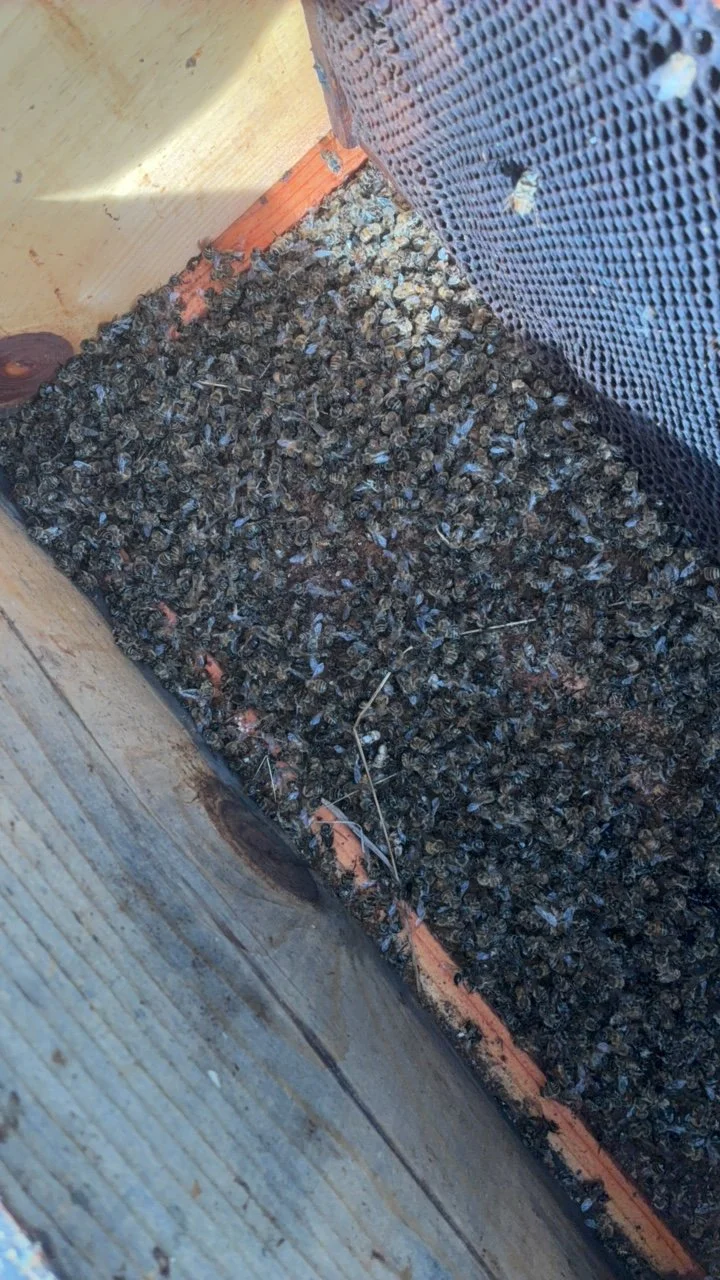
Photo: Hive dead out. North Dakota Department of Agriculture
Research Publications
This is not intended to be a comprehensive list of related research. Instead, it highlights publications that are either recent or particularly relevant for applied use.
De Miranda, J. R., Cordoni, G., & Budge, G. (2010). The acute bee paralysis virus–Kashmir bee virus–Israeli acute paralysis virus complex. Journal of invertebrate pathology, 103, S30-S47. https://doi.org/10.1016/j.jip.2009.06.014.
Genersch, E., & Aubert, M. (2010). Emerging and re-emerging viruses of the honey bee (Apis mellifera L.). Veterinary research, 41(6), 54. https://doi.org/10.1051/vetres/2010027
Lamas ZS, Rinkevich F, Garavito A, Shaulis A, Boncristiani D, et al. (2026) Viruses and vectors tied to honey bee colony losses. PLOS Pathogens 22(2): e1013939. https://doi.org/10.1371/journal.ppat.1013939
Ribière, M., Ball, B., & Aubert, M. (2008). Natural history and geographical distribution of honey bee viruses. Virology and the honey bee, 15-84.
Tantillo, G., Bottaro, M., Di Pinto, A., Martella, V., Di Pinto, P., & Terio, V. (2015). Virus Infections of Honeybees Apis Mellifera. Italian journal of food safety, 4(3), 5364. https://doi.org/10.4081/ijfs.2015.5364